07/11/2025
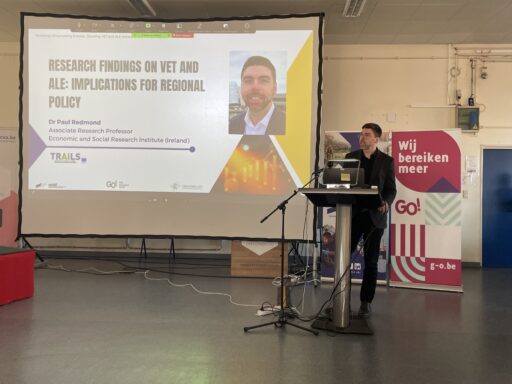
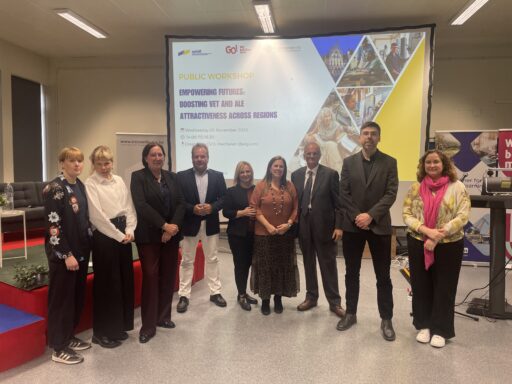
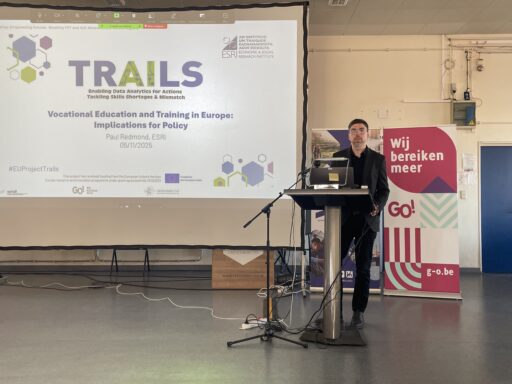
The TRAILS project took the spotlight at the EARLALL Workshop “Empowering Futures: Boosting VET and ALE Attractiveness Across Regions”, where Dr Paul Redmond, Associate Research Professor at the Economic and Social Research Institute (ESRI, Ireland), presented key research findings on participation in Vocational Education and Training (VET) and Adult Learning and Education (ALE).
The workshop, hosted by EARLALL in cooperation with Crescendo CVO and GO! Onderwijs van de Vlaamse Gemeenschap, was held in the framework of the 2025 EARLALL Annual Meeting on 5 November in Malines (Belgium). It brought together regional policymakers, European Commission representatives, and education experts to explore how to strengthen the appeal and value of VET and ALE across Europe.
The session was opened by Sabe de Graef, Councillor of the City of Mechelen, who emphasised the city’s ongoing efforts to reduce school dropout rates through partnership-based approaches that connect education, health, and employment sectors. Presentations by Jens Vermeersch (GO! Onderwijs van de Vlaamse Gemeenschap) and Marleen Mast (Crescendo CVO) showcased how Flanders is working to enhance the image of VET through high-quality teaching, collaboration with enterprises, and flexible learning paths for both young people and adults.
Moderated by Míriam Castillo González, Head of Unit for Programmes and Projects at the Directorate-General for Vocational Education and Training of Catalonia, the workshop set the tone with a clear message: VET and ALE should not be “second options,” but empowering first choices that open doors to meaningful careers and lifelong learning.
Against this backdrop, Dr Paul Redmond presented key findings from the TRAILS project, focusing on participation trends and barriers in VET and ALE, and their implications for regional policymaking.
He underlined that the attractiveness of vocational and adult education depends not only on the quality and relevance of training programmes, but also on social perceptions, the status of vocational careers, and the active involvement of employers. Drawing on TRAILS research across several European regions, Dr Redmond highlighted how data-driven policy design and skills intelligence can support regions in aligning education and training systems with evolving labour market and societal needs.
Dr Redmond’s contribution set the stage for a dynamic panel discussion featuring representatives from Baden-Württemberg, the Basque Country, Tuscany, Västra Götaland, and Switzerland, who shared their regional strategies for enhancing VET and ALE attractiveness. The discussion reflected a common commitment to translating research insights into concrete action through regional partnerships, social dialogue, and innovative learning models.
The exchange illustrated how the TRAILS project is helping to bridge the gap between research and policy, ensuring that evidence informs decision-making and contributes to more responsive, inclusive lifelong learning systems across Europe.
By contributing to the EARLALL workshop, TRAILS reaffirmed its mission to connect research and policymaking in the field of lifelong learning. Through its collaboration with regional and European partners, TRAILS continues to translate research results into actionable strategies that empower individuals, strengthen regional ecosystems, and help shape Europe’s future skills landscape.

This project has received funding from the European Union's Horizon Europe research and innovation programme under grant agreement No 101132673